

Guitar World gave it 4.5 out of 5 stars and called it the best mini practice amp they have ever tried. The Blackstar BEAM Mini, which shipped in March 2026 at $229.99, is the first production guitar amplifier to load Neural Amp Modeler (NAM) captures directly from the open-source Tone 3000 library. That library currently holds over 200,000 community-created amp captures, and it grows daily.
For $230, the BEAM Mini delivers twelve electric guitar amp models, three bass amp voices, two acoustic simulators, 35+ studio effects, Bluetooth audio streaming, an 18-hour rechargeable battery, and IP66 weatherproofing. It also functions as a USB-C audio interface, ships with Ableton Live Lite, and will add AI stem separation via Moises in August 2026. That is a lot of technology in a box that weighs 733 grams.
What Makes NAM Integration Different
Neural Amp Modeler is an open-source machine learning project that lets anyone capture the behavior of a real amplifier at the component level. The resulting “capture” file reproduces the amp’s gain structure, EQ response, and dynamic feel with remarkable accuracy. Think of it as a digital clone of a specific amp, built from measurements rather than manual modeling.
Until the BEAM Mini, loading NAM captures required a computer running a plugin or a dedicated unit like the Neural DSP Nano Cortex. Blackstar partnered with Tone 3000, the largest open-source NAM repository, to give BEAM Mini users direct access to captures via the companion app. That means a $230 desktop amp can now approximate the tone of a vintage Dumble, a modded JCM800, or a boutique Friedman that costs twenty times its price, all from captures created and shared by the community.
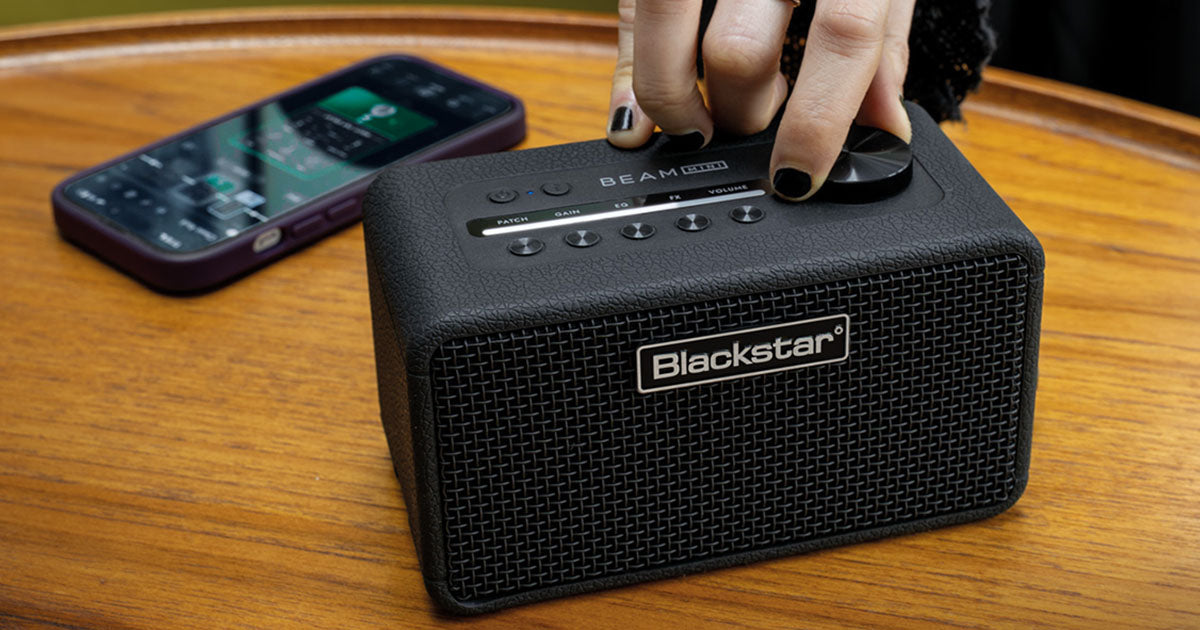
The BEAM Mini stores five patches on the device at a time. Swapping new captures in requires the mobile app, which runs on iOS and Android. Artist patches from Doug Aldrich, Gus G, and Will Sergeant are preloaded, giving players a starting point before diving into the Tone 3000 library.
Amp Models and Effects Without NAM

Even without loading a single NAM capture, the BEAM Mini holds its own. Blackstar built twelve electric guitar amp voices into the unit: six original Blackstar designs and six Ampton recreations of iconic amplifiers. The Ampton models use component-level digital modeling, which simulates the behavior of individual circuit components (capacitors, resistors, tubes) rather than matching the output waveform of a reference amp. The result is more natural response to pick dynamics and volume knob adjustments.
Blackstar’s patented ISF (Infinite Shape Feature) control blends the amp voicing between American and British tonal characteristics. Three bass amp voices and two acoustic simulators round out the amp section, making the BEAM Mini functional for bassists and acoustic players who want a quick practice solution.
The effects library includes 35+ studio-grade options spanning delay, reverb, modulation, compression, and drive categories. Guitar World noted that while the amp modeling quality is exceptional, some of the effects fall slightly short of that standard, which is a reasonable trade-off at this price point.
CabRig and the “In The Room” Sound
The BEAM Mini’s CabRig technology handles speaker and microphone simulation using impulse responses. Players can select different virtual cabinets and mic placements through the app, with the output processed through what Blackstar calls “In The Room” technology. The goal is to make the amp sound like a real cabinet positioned in front of you rather than a direct signal piped into headphones.
This matters because the BEAM Mini’s physical speakers, two 60mm full-range drivers paired with two passive bass radiators, are impressive for their size but cannot replicate the air-moving experience of a 4×12. CabRig bridges that gap when using headphones or the USB-C output for recording, delivering a more realistic monitoring experience than raw amp models alone.
Hardware and Build Quality
The industrial design targets portability without cutting corners. Blackstar collaborated with UK acoustics engineers on the sealed cabinet, which carries an IP66 dust and weather resistance rating. That means it survives beach sessions, backyard jams, and the inevitable coffee spill. The carry handle doubles as a tilt stand for desktop use.
The SpeedDial is the primary physical control: a single knob surrounded by a dynamic LED light ring (the “Light Beam” display) that provides visual feedback on parameter values. Dedicated buttons handle patch selection, effects on/off, gain, EQ, and volume. Blackstar calls this the “no menu” interface, and for quick tone adjustments it works. Deeper editing requires the app.
Battery life is rated at 18+ hours on a full charge via USB-C, with a recharge time under 2.5 hours. Bluetooth 5.8GHz handles wireless audio streaming with less than 6ms latency across a 35-meter range.
Moises Stem Separation: Coming August 2026
A software update scheduled for August 2026 will add Moises AI stem separation. This feature isolates or removes individual instruments from any song streamed via Bluetooth, letting players remove the guitar part and play along with the original bass, drums, and vocals. The JBL Bandbox Solo already offers similar functionality, but at $249 without the amp modeling depth that the BEAM Mini provides.
Competitive Landscape
The mini/desktop amp category is crowded. The Positive Grid Spark Go ($149) offers its own tone community via ToneCloud but lacks NAM compatibility. The JBL Bandbox Solo ($249) has stem separation now but is primarily a speaker with basic amp functionality. The Boss Katana Mini ($119) provides Boss reliability at a lower price point but without app integration, NAM, or wireless audio.
The BEAM Mini’s $229.99 price positions it as the premium option in the compact practice amp category, and the NAM integration is genuinely a first for any hardware amp at any price. For players who already browse Tone 3000 captures on their computer, having direct hardware access at this price is a meaningful step forward.
Specs at a Glance
| Spec | Detail |
|---|---|
| Price | $229.99 / £169 / €169 |
| Output | 2 x 12W RMS |
| Speakers | 2 x 60mm full-range + 2 passive bass radiators |
| Weight | 733g (1.6 lbs) |
| Battery | 18+ hours, USB-C recharge in under 2.5 hours |
| Amp Models | 12 electric, 3 bass, 2 acoustic |
| Effects | 35+ studio-grade |
| NAM Captures | 200,000+ via Tone 3000 |
| Connectivity | 1/4″ input, USB-C, Bluetooth 5.8GHz, 1/8″ headphone |
| Weatherproofing | IP66 dust and water resistant |
| Included Software | Ableton Live Lite |
| App | iOS and Android |